Sakondo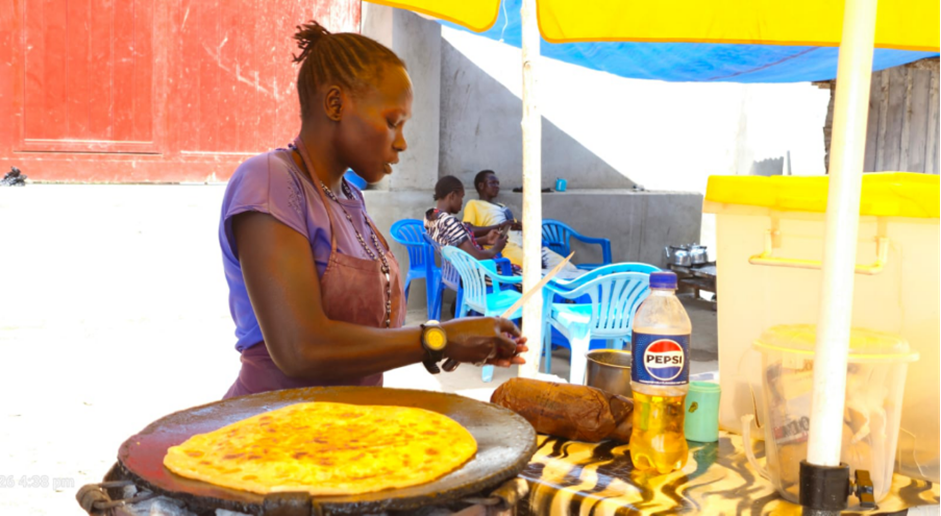
Before dawn, Madelina Poni sets out on foot through the sun-drenched streets of Juba, walking long distances to a roadside food stall where she spends the day flipping chapati over a charcoal stove.
The 23-year-old arrived in the capital in 2020, hoping to find work. Instead, she became trapped in a cycle familiar to many young women in South Sudan’s informal economy: unemployment, low wages and repeated harassment from local city authorities.
I stayed home for one month without a job,” Poni says at her workplace.
Her job is demanding, especially under the scorching heat of Juba. But she draws satisfaction in feeding the hungry mouths, mostly low-income earners who depend on roadside food kiosks like her workplace to neutralise hunger pangs.
Poni’s life tells the story of resilience punctuated by pain and human struggle. After arriving in the big city from Terekeka, she was lucky to land a waitress job in one of the restaurants in Hai Cinema. But that lasted just six months before she was laid off.
A second ended abruptly after thieves broke into her former workplace, stealing all the stock and every other valuable piece of equipment. That same morning, she was laid off.
I was only receiving SSP 15,000 per day,” she reveals of her meagre daily earnings, equivalent to one dollar by the then exchange rate. That salary, she says, was not enough to cover her rent, transport and basic needs.
For the next three months, Poni was thrown back into the unforgiving streets of Juba City, best known for limited opportunities and a city where the cost of living keeps soaring. “I was fired very early in the morning,” she recalls, the painful ordeal still fresh in her memories.
South Sudan’s fragile economy and its human toll
South Sudan’s economy has been battered by growing conflict, which births a humanitarian crisis.
A heavy import-dependent economy, the local currency has taken a beating from inflation as revenue from the sale of crude oil dwindles due to other biting factors like the Sudan war, which often leads to a cut in oil production.
Inflation surged further, eroding purchasing power and making basic goods far less affordable for ordinary households. People with low incomes, like Poni, are often pushed to the edge to eke out a living.
Unemployment remains high, with official estimates placing the overall jobless rate at around 23 per cent and youth unemployment substantially higher.
Living on the edge of survival
The most recent World Bank report indicates that around 92 per cent of South Sudanese live below the extreme poverty line, that is, less than about $2.15 per day, and nearly 80 per cent face food insecurity.
Salaries in both the public and private sectors are often delayed or fail to keep pace with inflation, pushing households, particularly women, into precarious livelihoods.
Poni never attended school, a reality she says limits her options. “I am not educated, but I have interest in doing a better job or opening my own business,” she said.
Turning Point: strength in the face of South Sudan’s glaring challenges
Her circumstances improved slightly after Ayango Irene, a small-scale food vendor in the city, hired her. “Life is a bit better now. My current boss treats me well,” Poni expressed with a smile.
Despite working in a challenging environment where she is exposed to sexual harassment and bullying, Poni says her new job has helped her gain basic customer service and hygiene experience, skills she hopes to use in her next step in life.
“Some men speak to me in a very disrespectful manner,” she said. “They ask if I am married, and I usually respond in the affirmative even though I am not, just to keep them away.”
At her current job, Poni earns around five dollars a day. She hopes to save a significant portion of her earnings to start her own business. “I plan to start my own chapati place,” she said. “But I don’t have startup capital.”
Poni learned how to make chapati from a Ugandan man who runs a food kiosk in her neighbourhood. Irene, 35, who is Poni’s current boss, says she recognises Poni’s struggle because she has experienced it herself.
“I started this business around 2020 while working under someone else,” Irene recalls of her journey into self-employment after she took over the stall from the initial owner, who withdrew her investment. She says the business survives largely on personal relationships she has created with her customers.
For the last four years, she has faced constant harassment from city authorities.
“They come and disturb us a lot,” she said, referring to municipal officials who periodically force roadside traders to move or confiscate goods. City authorities say roadside vendors must pay monthly fees and operate in designated areas, though traders complain enforcement is inconsistent.
Irene says traders are required to pay multiple fees, some formal, some less clear, to keep operating. “If you don’t comply, they take your property,” she said.
For women, she added, the pressures are compounded by harassment and social stigma. “Most families today are supported by women,” Irene said. “If you want to survive, you have to hustle.”
Across major towns and cities in South Sudan, small-scale businesses are predominantly dominated by women, who are often the primary breadwinners for most families. With little access to credit or social protection, many women say their survival depends on daily sales and on an economy yet to recover.